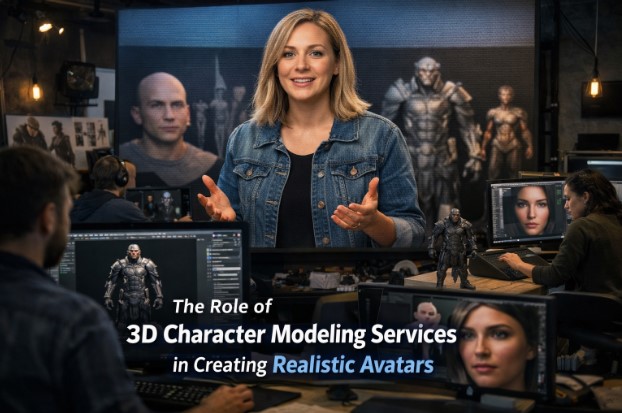
Digital characters have turned into more than just visual representations; they are coming to games, virtual worlds, simulations, and brands with the likes of personalities, emotions, and even identity.
The players and the users require such avatars that not only walk naturally, but also show many reactions and even seem animated on the display. The 3D character modeling services provide a pivotal bridge to that feeling.
They take concepts and sketches and give them life through expressive avatars that feel real, relatable, and captivating. For many studios, the partnership with a capable 3-D game art outsourcing studio is what makes this level of realism scalable.
From Concept to Character Identity
Every realistic avatar finds its origins in a good concept. Character modeling services then help translate written descriptions, career reference images, and mood boards into one cohesive digital identity. Facial structure, body anatomy, posture, and silhouette are designed with great attention in an attempt to embody a personal trait and backstory.
With a strong underpinning to work from, the avatar will feel as though it was created very much with purpose, as opposed to being merely random and generic. Animation is also simplified for those early design characters, making an easier transition to looking more believable once in a live environment.
Sculpting Natural Human Anatomy
Realism depends heavily on anatomy. Professional 3D character modeling services pay full attention to the real world’s proportions in terms of muscle flow, bone structure, and skin details. Anatomy remains the base of even the most stylized characters in the most indirect ways.
The positioning of the shoulders, the proportion of the hands, and the minute details of the joints are just a few of the subtle aspects that can either enhance or destroy the naturalness of the character’s appearance and behavior. In this way, animations will be perceived as smooth and not awkward, thus leading to higher immersion.
Facial Detail and Emotional Expression
Faces are where realism is tested most. People will notice an unnatural expression or eyes without life. More high-quality modeling of characters would do facial topology that supports believable expression, believable blinking, lip movement, and emotions.
Even the littlest detail, like skin folds, asymmetry, and micro-expression, places avatars in a living position, rather than sculpted. This level of precision in detailed facial data becomes especially important in games, social platforms, and virtual reality environments where characters get closely integrated with the users.
Texturing and Surface Realism
A good character model feels lifeless without appropriate textures that add realism; in contrast to the skin tone, a few examples of this include wear and tear on fabrics, very minute imperfections, and a response of the material under light. Character Modeling Services use the advanced texturing technique to avoid such flatness or artificiality from coming into existence.
Be it the realistic skin shaders or the patterned fabrics in stylized subject matter, textures define how the character lives in that space. This kind of attention to surface detail gives avatars a different reality, one not merely digital.
Optimisation Without Losing Detail
However, realistic avatars have to operate efficiently as well. For such a balance, an expert 3D game art outsourcing studio typically knows the line between visual beauty and the technical requisites.
Characters can now be optimized so that they can run well on different platforms without compromising on the core features. Clean topology, productive UVs, and intelligent use of maps ensure that any character is expressive but at the same time meets engine restrictions.
This balance is critical for games, real-time simulations, and interactive experiences where performance matters as much as appearance.
Consistency Across Multiple Characters
On a larger scale, realism is maintained through consistency. Character modeling services maintain a unified style, scale, and level of detail among different avatars. This helps the world feel coherent instead of being patched together.
Outsourcing studios will usually establish common guidelines and asset standards so that characters feel as though they belong to the same universe, even when they are developed in parallel, therefore, giving a real boost to large games with huge casts or evolving content.
Supporting Long-Term Character Use
Realistic avatars are rarely single-use assets. They go through updates, expansions, and new platforms. A professional service in 3D character modeling designs characters with flexibility.
The models are practically made so that outfits, accessories, or facial changes or enhancements can be added later without having to start from scratch. This forward way of thinking saves time and cost while keeping the characters relevant over an extended period.
Conclusion
Realistic avatars are the product of a combination of meticulous design, technical competence, and artistic knowledge. The different ingredients of 3D character modeling services, such as anatomy, expression, texture, and performance, are brought together to create living and animated characters.
It is through an experienced 3D game art outsourcing studio that these avatars become more than a graphic representation. Rather, they assume the role of credible digital beings that can interact with users, thus aiding the process of storytelling and being part of the overall experience.
