From spatial data analysis and decision-making to the visualization of complex geographies, Geographic Information Systems have become an indispensable tool. With the rise of various industries reliant on GIS, such as urban planning, transportation, environmental science, real estate, and logistics, comes a greater demand for clearer, more intuitive, and dynamic visual representations.
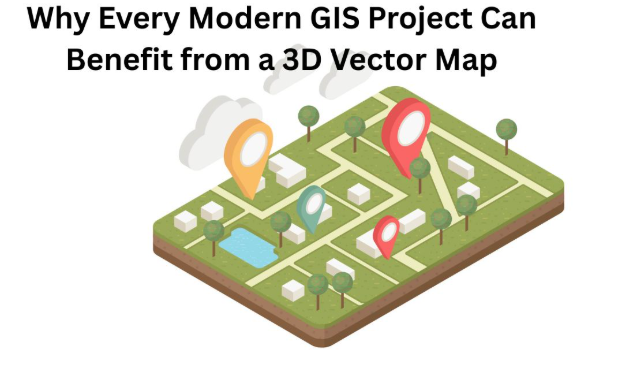
That has been the shift toward embracing the 3D vector map: a compelling evolution in the use of traditional mapping enhanced with dimensional depth and vector precision.
Since these maps are constructed of 3D vector graphics, they provide the level of visual realism and computational efficiency needed in modern GIS workflows.
Here are the main reasons why GIS projects today benefit considerably from 3D vector-based mapping.
1. Providing Highly Accurate and Scalable Geographic Visualization
Accuracy and scalability are the hallmarks of GIS. A 3D vector map delivers on both fronts, using mathematical paths to represent terrain, structures, and boundaries with exact precision. Unlike raster maps, which tend to pixelate upon zooming, 3D visuals rendered using vectors remain razor-sharp, irrespective of zoom level or screen size.
This precision is critical for:
- Detailed terrain modeling
- Infrastructure planning
- High-resolution mapping displays
- Multi-scale GIS Dashboards
It handles information of any scale, enabling the user to analyze the small and big-picture patterns without switching formats on a map.
2. Enhanced Spatial Understanding through Realistic 3D Terrain and Structures
Classic 2D maps usually cannot depict the physical geometry of landforms, such as relative relief, intricate slope patterns, or building heights. A 3D vector map extends this capability by adding depth and another dimension to the display of GIS information.
This enhances spatial understanding since it becomes easier to interpret:
- Mountain ranges and valleys
- Flood Plains and drainage paths
- Urban skylines and building relationships
- Land-use patterns and a change in zoning
This added realism supports planners, engineers, and analysts in making better decisions based on a clear visual context.
3. Improved Data Representation to Support Enhanced GIS Analysis
Most GIS calculations are based on elevation, volume, and surface geometry representation. Based on the capabilities of 3D vector graphics, the GIS platform can better represent and analyze the features of terrain.
Improved representation supports:
- Flood risk modeling
- Slope and Aspect Analysis
- Infrastructure layout planning
- Environmental Impact Studies
Where geographic data is more visually interpretable, the accuracy of analysis improves at every stage of a GIS project.
4. Making Interactive GIS Applications More Dynamic and Accessible
With modern GIS tools becoming increasingly web-based and interactive, visuals need to load quickly, respond smoothly, and adapt to users. Being lightweight and scalable, 3D vector maps are easily integrated into various interactive GIS dashboards and web platforms.
They improve user experience by providing:
- Rotation, zoom and tilt in real time
- Dynamic layers and overlays
- Smoother transitions between locations
- Animated spatial storytelling
Capabilities like these make such projects with GIS more accessible to both experts and the general public alike.
5. Reducing File Size and Improving Performance on Multiple Platforms
Large 3D models based on raster systems do not load and render easily, certainly not in web environments. In comparison, 3D vector graphics prove much more efficient; therefore, GIS systems are able to deliver fine visual results with neither overloading memory nor processing power.
Performance benefits include:
- Faster loading maps
- Lower bandwidth requirements
- Better performance on mobile devices
- Carried-through clarity on high-resolution displays
These advantages make vector-based 3D maps particularly useful in massive or cloud-based GIS applications.
6. Customization for Industry-Specific GIS Applications
Different industries demand different types of map visualization. Since 3D vector maps are easily editable, designers can adjust colors, shapes, line weights, and layers according to the needs of a particular project.
Examples include:
- Utility networks, such as electrical and water systems
- Mapping of cultural heritage and tourism
- Real estate development proposals
- Transportation route planning
- Environmental monitoring dashboards
3D vector graphics with customization ensure clear communication of a GIS map that is in line with the visual and functional goals of the project.
7. Improvement of Stakeholder Communication and Presentation Quality
Clearly displayed visuals allow for the communication of serious geographic insights to stakeholders who do not necessarily have to be sound technically in using GIS. Teams can present data in intuitive and more visually engaging ways using a 3D vector map.
Improved communication supports:
- Public planning meetings
- Investor presentations
- Policy discussions
- Outreach to the Community
- Corporate decision-making
With better clarity into geographic data, stakeholders can make more confident and better decisions.
8. VR, AR, and Simulation Readiness Support the Future of GIS
The importance of vector-based 3D mapping increases with each step in immersive experiences that GIS technology develops. Being lightweight, scalable, and editable, 3D vector maps easily integrate into VR and AR environments.
This enables:
- Virtual city tours
- 3D landscape simulations
- Navigation training environments
- Immersive Environmental Analysis
Conclusion
A 3D vector map is much more than a visual enhancement; it is a game-changer for modern GIS projects. Driven by the versatility of 3D vector graphics, these maps give way to deeper clarity, better communication, and smoother workflows.
The contribution of 3D vector-based mapping will continue to be very important to drive meaningful spatial understanding with growing GIS applications, from smart cities to environmental monitoring, in this ever-evolving digital world.
